

Introduction
You have probably heard the term multi level marketing and felt confused. Is it a real job? Is it a scam? You are not alone.

Many people mix up MLM with pyramid schemes, and that uncertainty keeps job seekers from exploring legitimate opportunities. The truth is, multi level marketing can be a legal business model, but it comes with real risks.
In 2026, the MLM industry still pulls in massive revenue. One report shows it hit $201 billion in 2024, yet most distributors actually lose money (source). That is why understanding how MLM compensation plans work is so important. Some plans like matrix or binary structures pay differently, and not all are created equal (compare them here).
But here is the thing: not every commission based sales opportunity is MLM. There are high ticket affiliate programs where you earn $500 to $5000 per sale without recruiting a team (learn more). Full time sales jobs in remote settings also offer stable income without the multi-level structure.
This guide will help you tell the difference between a viable path and a risky venture. We focus on helping ambitious sales professionals like you make smart choices, especially if you are considering high ticket remote sales.
If you are ready to explore real opportunities, our team can help you take the next step. Contact us to learn how to build a high-earning closing career.
What Is Multi-Level Marketing? Definition and Core Characteristics
So, what exactly is multi level marketing? In simple terms, it is a direct selling strategy where you earn commissions from two sources: your own sales and the sales made by people you recruit into the business. Think of it as a way to build a sales team underneath you, and you get paid a percentage of what everyone on your team sells.
Here is how it works. You join a company, often buying a starter kit or minimum product inventory. Then you sell products directly to customers. But the real earning potential, according to the company, comes from building a network of distributors below you. The more people you bring in and the more they sell, the more you earn. This is why MLM is also called network marketing. Different companies use different payout structures like binary plans, matrix plans, or unilevel plans to calculate your commissions. For example, a binary plan lets you have two sales legs, or teams, under you. A matrix plan limits how many people can sit in your downline at each level (source).
The core traits of any MLM opportunity include:
- A hierarchical compensation structure where your earnings depend on your team’s performance
- Strong emphasis on recruiting new members to grow your downline
- Revenue streams tied to product sales
This last point is the most important one. What separates a legitimate MLM from an illegal pyramid scheme? The answer is simple: a real MLM focuses primarily on selling actual products or services to real customers. A pyramid scheme, on the other hand, is just about paying to join and then recruiting others to pay in too, with little to no real product moving.
If the only way to make money is by recruiting new people, that is a red flag.
Now, not every commission based sales role works this way. High ticket affiliate programs, for example, pay you a big flat commission per sale without requiring you to recruit anyone. That is a very different path from multi level marketing. If you are considering a sales career and want to avoid the pressure of constant recruiting, there are better options. For instance, you can find real full time sales jobs that offer stable income and a clear career path without the multi-level structure. You can learn more about finding these opportunities in our guide to high ticket remote sales jobs.
If you want to explore a legitimate path where your income depends on your closing skills, not your recruiting ability, we can help. Contact Our Team to discuss how to build a high-earning closing career.
Common MLM Compensation Structures: Unilevel, Binary, Matrix, and Stair-Step
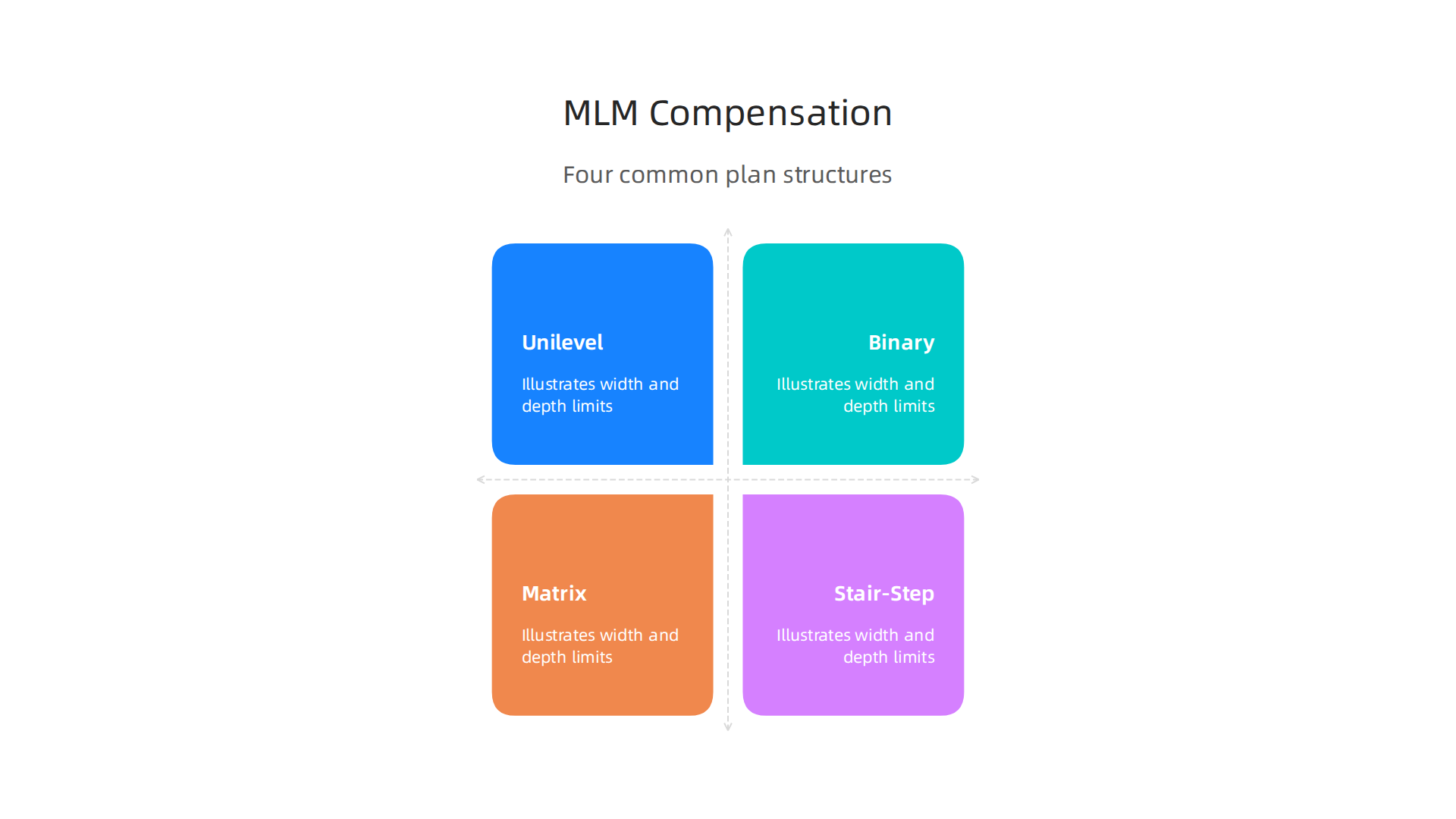
Now that you know the basics of multi level marketing, it helps to understand how distributors actually get paid. Every MLM company uses a compensation plan to calculate commissions. And not all plans are the same. In fact, the way a company pays you can tell you a lot about how hard it will be to earn money. Here are the four most common structures you will see in 2026.
Unilevel Plans
A unilevel plan is one of the simplest. You earn commissions on sales from everyone you personally recruit, and sometimes from a few levels below you. But there is often a limit on how wide your downline can be. This means you can only have so many people directly under you. The plan rewards you for building a broad team, but you have to keep recruiting to grow your width. Many newer MLM companies use this model because it is easy to explain (source).
Binary Plans
A binary plan splits your downline into two legs. Think of it as a left side and a right side. You get paid based on the weaker leg’s sales volume. So if your left side sells $10,000 but your right side sells only $2,000, your commission is calculated on the $2,000. This structure encourages you to balance both legs. It can be frustrating because one strong leg does not help much if the other leg is weak. The binary plan is one of the most popular MLM structures today (source).
Matrix Plans
A matrix plan limits both the width and depth of your downline. For example, a 3×3 matrix means you can have three people directly under you, and each of them can have three people, and so on down three levels. This creates a fixed structure. It makes the business seem simple, but it also creates competition. New recruits have to be placed somewhere in the matrix, and not everyone gets the best positions. Some people call this a forced matrix because you cannot add extra people in a level once it is full (source).
Stair-Step Plans
A stair-step plan is often called a “plan within a plan.” It combines elements of unilevel, binary, or matrix plans in a tiered structure. As you move up in rank, your commission percentage increases. But to stay at a higher rank, you and your downline must hit certain sales targets every month. This can create a lot of pressure to keep buying products yourself just to qualify. Many established MLMs use a stair-step approach because it rewards loyalty and consistency (source).
Understanding these compensation plans is key before you join any MLM opportunity. If you are looking for a simpler way to earn commission based sales income without building a downline, consider high ticket affiliate programs or a full time sales jobs that pay you directly for your sales skill. Spend your time, not by always pushing others to join. Instead, learn to close bigger deals on your own.
If you want to build a career where your closing skills decide your income, not your recruiting ability, we can help. Contact Our Team to see how you can start a path in high-ticket remote sales.
How MLM Commissions and Bonuses Are Calculated: Overrides, Breakouts, and Rank Advancements
Now you know the structures of multi level marketing plans. But how does the money actually flow? When a sale happens, the commission doesn’t just go to one person. It splits between several people in the downline. And there are bonuses that push you to keep climbing ranks. Let’s break it down simply.
Personal Sales Commissions
First, you earn a direct commission on products you sell yourself. This part is simple. If you sell $100 worth of product and your commission rate is 25%, you make $25 (source). Some companies call this your personal volume (PV). You must hit a minimum PV each month to qualify for any other bonuses.
Downline Overrides
Next come overrides. These are commissions you earn on sales made by people you recruited and their recruits. For example, you might get 5% on sales from your downline members who are two levels deep. The deeper your team, the more overrides you earn. But here is the catch. If someone in your downline goes inactive, any unpaid commissions from that leg might disappear. This is called breakage.
Breakage happens when unearned commissions from inactive downline legs go back to the company or the upline (source). So if a distributor stops selling, their future commissions stop. And the company keeps that money. It is a built-in leakage that makes it harder for you to earn passive income.
Rank Advancement Bonuses
Many MLMs push you to reach higher ranks. When you hit a new rank, you unlock bigger commission percentages and special bonuses. In fact, more than a third of breakaway and unilevel plans offer a rank advancement bonus (source). These bonuses can be a one-time cash payment or a permanent higher commission rate. But to stay at that rank, you and your team must hit monthly sales targets. This creates a strong incentive to keep recruiting and buying product yourself.
All these layers mean your paycheck depends heavily on your team’s activity, not just your own sales. If your downline stops working, your income drops fast.
If you want an income that rewards your own sales skill instead of your ability to recruit, consider a different path. Many people find success with high ticket affiliate programs or full time sales jobs in remote closing. You earn commission based sales income directly from your closes, not from building a downline.
Want to learn a simpler way to earn big commissions? Check out The Simple Method to Start a Remote Sales Side Hustle in 2026. Or Contact Our Team to explore a career where your closing skills decide your income.
The Financial Reality: Earnings, Attrition, and Time Commitment in MLM
So you understand how commissions and bonuses work in multi level marketing. But here is the hard truth. Most people in MLM never make real money. In fact, most lose money after you subtract startup kits, monthly product purchases, training materials, and travel to events.
What Most People Actually Earn
The numbers are sobering. A huge percentage of MLM participants earn little to nothing. You might hear stories about the top earners. But those stories hide the fact that less than 1% of distributors ever reach high income levels. The rest earn small amounts, often less than minimum wage. And because many MLMs require you to buy products each month to stay active, your expenses can eat up any small commission you earn. You can plug your numbers into an MLM commission calculator to see how the math works for your specific situation. But the reality is that for most people, the numbers do not add up.
The Dropout Problem
Attrition rates in MLM are brutal. More than 90% of new distributors quit within the first year. Think about that. Nine out of ten people who join give up. Why? Because they realize the income is not there, or they get tired of pushing friends and family to buy products or join their downline. The structure of compensation plans makes it hard to earn anything until you have a large, active team. And when people keep quitting, you have to keep recruiting just to stay in the same place. It becomes a treadmill.
The Time Trade Off
Even if you somehow stick with it, the time commitment is massive. To earn meaningful money, you need to work at it like a full time sales job. You spend hours every day prospecting, following up, training your downline, and attending meetings. All of this with no guaranteed base pay. If you have a bad month, you earn zero. You might even owe money if you bought inventory you cannot sell.
This is why many people eventually look for a better path. Instead of relying on a downline that quits on you, imagine earning commission based sales income directly from your own skill. That is what high ticket affiliate programs and remote closing offer. You become a sales representative for real products or services. You close deals. You get paid. No downline required.
If you want a career where your effort and ability decide your paycheck, not the success of people you recruit, consider remote closing. It is a simpler model with much better odds.
Ready to make a change? Contact Our Team to learn how you can start a career in high ticket sales today. Or check out this simple method to start a remote sales side hustle in 2026 to see what is possible.
Regulatory Landscape: FTC Guidelines and How to Spot an Illegal Pyramid Scheme
So how do you know if a multi level marketing company is legal or just a pyramid scheme in disguise? The Federal Trade Commission (FTC) has clear rules on this. And in 2026, those rules matter more than ever.

The FTC uses specific criteria to tell the difference. Legal MLMs earn most of their money from selling real products to real customers. Pyramid schemes earn money by recruiting new members. That is the big difference. If the company pays you more for recruiting than for selling, that is a warning sign.
Red Flags to Watch For
The FTC has published guidance that highlights two key factors. First, does the company reward product sales or recruitment? Second, do distributors actually sell products to people outside the organization? If the answers point toward recruitment, you are looking at a problem.
Here are the red flags the FTC warns about:
- High upfront costs for starter kits or inventory
- Inventory loading where you must buy products you cannot sell
- Compensation that mostly rewards recruiting new members instead of selling products
- Pressure to recruit friends and family quickly
The latest FTC guidance from 2024 gives even more detail on what makes a compensation structure unlawful. And the FTC’s consumer advice page tells you to watch for these signs before you join.
A Better Path Forward
Here is the thing. Once you know these rules, you can see why so many MLM companies operate right on the edge. And why most participants lose money. Instead of betting on a system that depends on recruitment, imagine earning commission based sales income through high ticket affiliate programs. Those are real full time sales jobs where you get paid for your own results. No downline. No inventory. No pyramid risk.
If you want a career you can trust, check out this guide on how to find high ticket remote sales jobs in 2026. And when you are ready to take the next step, our team can help.
Get Started today and build a career with real earning potential.
Benefits and Drawbacks of MLM Participation: A Balanced View
It is easy to see why people are drawn to multi level marketing opportunities. Companies promise flexible hours, low startup costs, and a supportive community. Those perks sound great, especially if you are looking for part-time work or a way to earn extra cash. The FTC’s consumer advice page even acknowledges that some MLMs can be legal.
But here is the reality. The benefits are often overstated. The flexible hours mean you are always “on call” to recruit or sell. The low barrier to entry comes with pressure to buy inventory you cannot sell. And the community support can quickly turn into pressure when you do not meet goals.
The Hard Truth About Earnings
The biggest drawback is simple. Most people do not make money. The latest FTC guidance makes it clear that only a tiny fraction of participants ever see the lifestyle shown in marketing materials. Drop-out rates are extremely high. Many people lose money instead of earning it.
On top of that, MLM participation can strain personal relationships. You are encouraged to sell to friends and family. That can damage trust. And there is a reputational risk. Once people know you are in an MLM, they may see you differently.
A Better Way to Earn
Instead of betting on a system where most people fail, consider a different path. Commission based sales in high ticket affiliate programs let you earn real income without a downline. You work as a sales representative or get a full time sales jobs that pays for your results, not your recruits. No inventory. No pressure on your friends. Just honest work.
If that sounds better, check out this guide to high ticket remote sales jobs in 2026. And when you are ready to make the switch, our team is here to help.
Get Started today and build a career that actually works for you.
MLM vs. High-Ticket Remote Sales: Which Path Aligns with Your Goals?
Now that you have seen the real numbers behind multi level marketing, you might be wondering what else is out there. If your main goal is to earn a stable, high income without the pressure of recruiting your friends, it is time to look at the other side of the coin. Let’s compare MLM to something called high-ticket remote sales.
The Core Difference: Recruitment vs. Skill
In an MLM, your income depends heavily on your downline. You need to recruit new members to build your team and earn commissions on their sales and their recruits’ sales. As MLM compensation plan analyses in 2026 show, these structures are designed to reward recruitment heavily. Even if a matrix plan can offer high earning potential at the top, the data on MLM profitability in 2026 still shows that most distributors lose money.
High-ticket remote sales works differently. You are hired as a sales representative or closer. Your job is to talk to interested customers, build relationships, and close deals on products or services that cost a few thousand dollars or more. There is no downline. Your paycheck comes from your own skill, not from bringing in other sellers.
The Paycheck: Predictable vs. Gamble
Most legitimate commission based sales roles offer a base salary plus commission. Recent sales compensation stats from 2026 show that general sales representatives have a median base salary of over $63,000 per year. Add commissions on top of that, and your total earnings can range from $60,000 to well over $200,000 annually, especially in high-ticket remote sales careers.
In an MLM, you usually have no base salary. You pay for your own products and marketing materials. You only earn when you sell or when someone you recruited sells. That is a gamble, not a career.
Training and Career Path
Finally, consider the support you get. A real full time sales jobs employer provides formal training, sales scripts, a manager, and a clear career ladder. You can grow from sales development rep to account executive to sales manager. An MLM gives you a packet of materials and tells you to go sell to everyone you know.
If your goal is a stable, scalable, and professional career where your income reflects your talent, high-ticket remote sales is almost always the better choice.
Ready to build a real career? Contact Our Team and let us help you take the first step.
A Due Diligence Checklist: How to Evaluate Any MLM Opportunity
You now know the differences between multi level marketing and a real sales career. But maybe you still want to look at an opportunity that a friend invited you to join. That is fair. The smartest thing you can do is stop and check the facts before you spend any money.
Think of this as your own safety check. A due diligence checklist helps you spot the red flags early. Here are the three most important things to look at.
Check the Product First
Ask yourself one simple question. Who actually buys this product? You want to find out if the item sells to real customers outside the company. If the only people buying are other distributors, that is a warning sign. A solid checklist asks: "Is the product a good value at retail price?" Open a browser and search for the product name. See if regular people are reviewing it. If you only find posts from distributors, be careful.
Study the Compensation Plan
This is where the math matters. Look at how the company pays its people. What percentage of total payouts comes from recruiting new members versus actual product sales? If most of the money flows to people who build a downline, the business is built on recruitment. As we saw earlier, most distributors lose money in these plans. A strong company pays its sales force for selling to real customers, not for bringing in more sellers.
Research the Company History
Do not trust the hype. Take time to investigate the company leaders and any past legal issues. Look for complaints with the Better Business Bureau or the Federal Trade Commission. Search for news articles about the company name plus the word "lawsuit." If you see a pattern of regulatory trouble, walk away.
Taking these steps will save you time and money. If this checklist makes you want a simpler, more reliable path, contact our team. We can help you start a career in high-ticket remote sales instead of wondering if your MLM investment will pay off.
Summary
This article explains what multi level marketing (MLM) is, how common compensation plans work, and why most participants struggle to earn meaningful income. It breaks down unilevel, binary, matrix, and stair-step plans, then shows how personal commissions, overrides, and rank bonuses are calculated and why breakage and attrition hurt earnings. You’ll read the financial reality — high dropout rates, frequent losses after expenses, and heavy time commitments — and learn the FTC red flags that distinguish legal MLMs from illegal pyramid schemes. The guide gives a practical due-diligence checklist for evaluating opportunities and presents a balanced view of benefits and drawbacks. Finally, it compares MLM to safer alternatives like high-ticket affiliate programs and remote sales jobs so you can choose a career path based on selling skill rather than recruiting.