
Introduction
Looking for a high-paying remote sales job on Glassdoor can feel like a full-time job itself. You search for "glassdoor jobs," scroll through endless listings, and often end up wondering which opportunities are real and which are just noise.
But here’s the thing. High-ticket remote sales offers serious income potential. According to the latest sales compensation statistics for 2026, top performers in this space are earning well above average. The money is there if you know where to look.
The problem is that general job boards like Glassdoor make it hard to separate the gold from the garbage. Many job seekers waste time applying to roles that are scams or lead nowhere. You might even find yourself browsing "remote jobs reddit" threads just to figure out which companies are legit. Sound familiar?
That’s why we put together this expert framework. It’s designed to help ambitious sales professionals like you navigate Glassdoor Jobs with a clear, proven strategy. No more guessing. No more frustration.
We’ll show you how to identify the real "best remote jobs," spot high-quality "sales jobs" that actually pay well, and avoid the traps that waste your time. You’ll learn how to use the platform like a pro, not just a casual searcher.
If you want a deeper look at the entire process, check out our complete guide to finding high-ticket remote sales jobs in 2026. It covers everything from identifying the right roles to acing the interview.
For now, let’s start with the basics. Let’s talk about how to turn your job search into a career breakthrough.
Understanding the High-Ticket Remote Sales Landscape in 2026
Let’s start by getting clear on what we’re actually looking for. When you browse glassdoor jobs or do an indeed job search for sales roles, you see a lot of variety. Some jobs pay $40,000. Others claim $200,000. The gap is huge, and it’s confusing.
High-ticket remote sales is its own category. It’s not about selling low-cost items like subscriptions or consumer goods. Instead, it focuses on closing big deals. Think B2B software, enterprise consulting, or high-end coaching packages. These deals can range from $5,000 to over $100,000 per sale. That’s why the income potential is so much higher.
In 2026, the demand for skilled closers is stronger than ever. Companies have realized that remote work is here to stay. They are hiring closers from anywhere, not just in expensive cities. According to recent sales compensation statistics, top performers in high-ticket roles are earning well above the six-figure mark. In fact, many hit $200,000 or more annually when you factor in commissions.
So why does this matter for your job search? Because the best remote jobs on Glassdoor and Indeed aren’t always labeled clearly. A generic "sales representative" posting might actually be a high-ticket closer role. But you have to know how to spot it.
Here’s the key difference between high-ticket and traditional sales:
| Traditional Sales | High-Ticket Sales |
|---|---|
| Small deal sizes ($50–$500) | Large deal sizes ($5,000+) |
| High volume, many transactions | Lower volume, fewer transactions |
| Often B2C or low-tier B2B | Almost always B2B or enterprise |
| Base salary plus small commissions | Base plus large commissions (often 10–20%) |
| Less specialization needed | Requires advanced closing skills |
If you scroll through "remote jobs reddit" threads, you’ll see people complaining about low pay and high pressure. But those complaints usually come from traditional sales roles. High-ticket sales is different. It rewards skill over luck. And in 2026, companies are paying a premium for closers who can handle long sales cycles and build trust with decision makers.
Another trend driving this market is the shift to performance-based pay. More companies are using personalized compensation structures to attract top talent, as highlighted by the 2026 sales comp trends. That means if you prove yourself, your earning potential goes up fast.
Now, you might be wondering how to actually break into this world. Many successful closers started with a side hustle to build their skills. If that sounds like you, we have a guide that covers starting a remote sales side hustle in 2026. It’s a smart way to gain experience without quitting your day job.
For now, just remember this: high-ticket remote sales is a real, lucrative path. But you can’t find it by accident. You need a targeted strategy to uncover the sales jobs that truly offer $100K+ potential. That’s exactly what we’ll cover next.
Why Glassdoor Is Your Best Bet for Finding Legitimate Opportunities
You’ve probably spent hours scrolling through glassdoor jobs listings, but are you using the site the right way? Most job seekers just type in a keyword and click apply. That’s a mistake, especially when you’re hunting for high-ticket sales roles.
Here’s the thing: Glassdoor gives you something no other job board does. It shows you the inside story. Company reviews, salary numbers, and interview insights.

And in 2026, when remote sales scams are everywhere, that transparency is gold.
Let’s break down the three features that make Glassdoor a must-use tool.
Company Reviews: See What Employees Really Think
Before you apply to a sales job, you need to know the company culture. Is it a sweatshop or a supportive team? With Glassdoor, you can read honest reviews from current and former employees. You’ll spot red flags fast. For example, if you see multiple reviews saying "high pressure" and "unrealistic quotas," you know to steer clear. You can also filter by "remote" reviews to see what it’s like working from home. According to Glassdoor’s Worklife Trends 2026 report, there’s a growing divide between workers and leaders. Reviews help you see which side a company is on.
Salary Transparency: Know Your Worth
High-ticket sales roles often have a base plus commission. But what’s the real number? Glassdoor shows salary ranges, including commission and bonuses. For instance, the average total pay for a remote sales role is over $120,000 per year in the U.S. That’s massive. Compare that to an indeed job search where you often see only base pay. On Glassdoor, you can see if a "sales representative" job is actually paying $50K or $150K. That alone saves hours of wasted applications.
Interview Insights: Prep the Right Way
High-ticket sales interviews are tough. You might face role plays, case studies, or panel presentations. Glassdoor has a database of interview questions submitted by people who went through the process. You can search by company and role type. This is a complete game changer. You walk in knowing exactly what to expect.
How It Compares to Other Boards
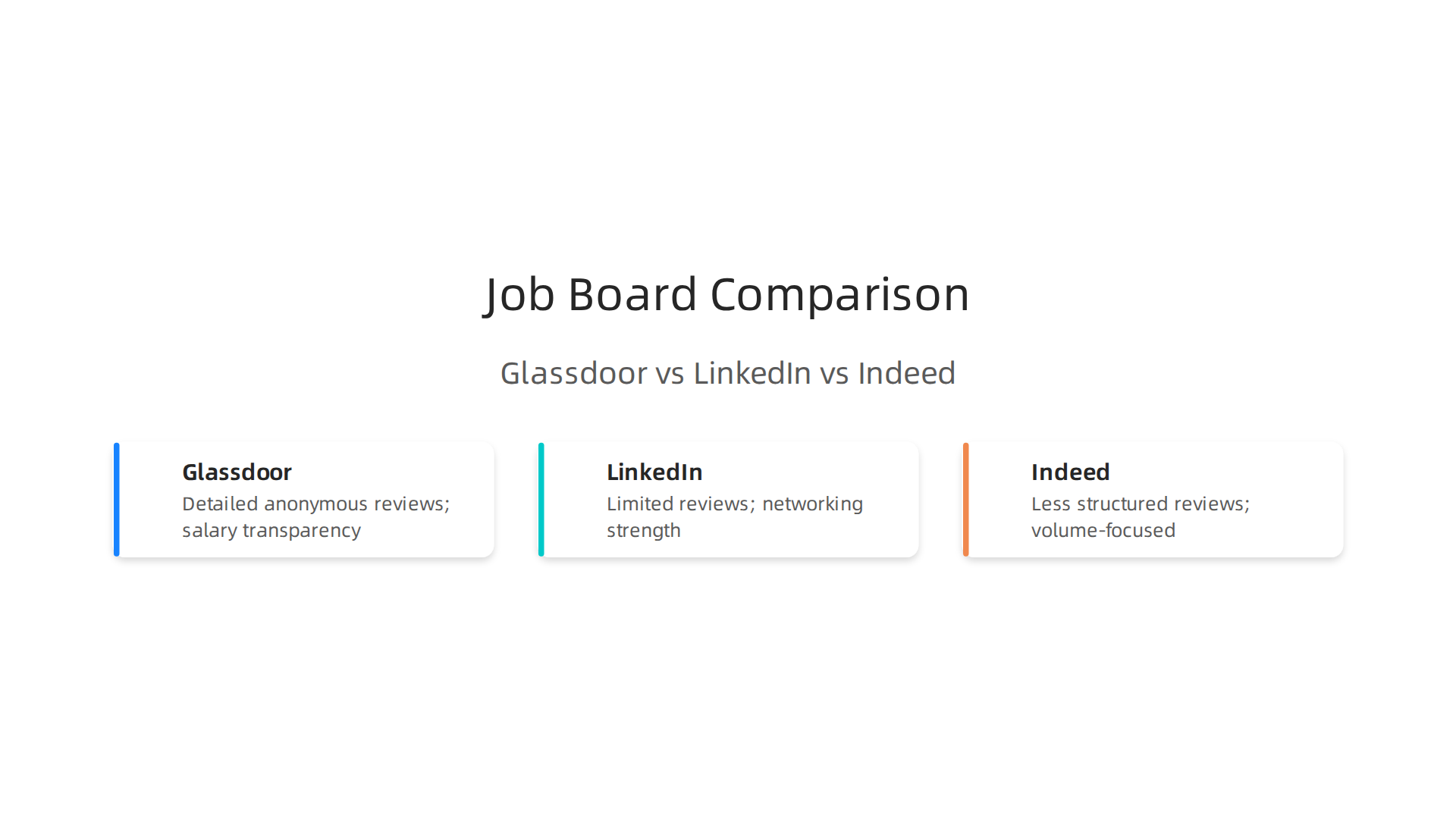
LinkedIn is great for networking. Indeed is good for volume. But neither gives you the full picture. On LinkedIn, every company looks perfect. On Indeed, you get speed but not depth. Glassdoor sits in the sweet spot. It’s the only place where you get salary data, honest reviews, and interview prep in one spot. And when you’re looking for the best remote jobs, that combination is priceless.
A Quick Comparison
| Feature | Glassdoor | Indeed | |
|---|---|---|---|
| Company reviews | Yes, detailed and anonymous | Limited (mostly recruiter posts) | Yes, but less structured |
| Salary transparency | Very high (commission included) | Sometimes (user-reposted) | Often shows only base |
| Interview insights | Large database | Some user comments | Rare |
| Best for high-ticket sales | Excellent | Good for networking | Fair for volume |
How to Start Using Glassdoor Like a Pro
Don’t just search "sales jobs." Use filters. Filter by "remote" and look for roles with "commission" or "high-ticket" in the description. Read at least five reviews before applying. Check the salary range. If a job says "uncapped commission" but has bad reviews about pay, be careful.
For a complete step-by-step system to find and land these roles, check out our guide on finding high-ticket remote sales jobs in 2026. It covers the exact search strings and application strategies that work today.
And if you still see posts on "remote jobs reddit" complaining about scams, remember: smart vetting solves that problem. Glassdoor gives you the tools. You just need to use them.
Setting Up Your Glassdoor Profile for Maximum Visibility
You know Glassdoor is great for research. But here is the part most people miss: recruiters actively search for candidates on Glassdoor. If your profile is empty or generic, they scroll right past you. If it is optimized, you get noticed. That is a huge advantage when you are looking for the best remote jobs in high-ticket sales.
Most job seekers set up their profile in five minutes and never touch it again. That is a mistake. In 2026, with hiring processes taking longer than ever, you need every edge you can get. Job seekers are facing longer hiring times as companies screen more carefully. A strong profile helps you stand out early.
Sell Your Skills with the Right Keywords
Recruiters search for specific terms. They type things like "closer," "B2B sales," or "high-ticket closing." Make sure those words show up in your profile naturally. Do not just list your old job titles. Describe what you actually did. For example, "Closed $50K+ enterprise deals with a 30% close rate" is powerful. "Handled sales accounts" is forgettable. Use numbers. Use action verbs. Speak the language of the sales jobs you want.
Optimize Your ‘Open to Work’ Settings
This feature is gold. When you turn on "Open to Work," recruiters can find you even when you are not applying. But you have to set it up right. Add your target role as "Remote Sales Representative" or "High-Ticket Closer." Include your desired salary range. Upload a clean resume that highlights your closing skills. Set your location to "Remote." That simple change makes you visible to companies hiring nationwide. It is how you stop chasing posts on "remote jobs reddit" and start getting direct messages from hiring managers.
Write a Headline and Summary That Pop
Your headline appears right under your name. It is the first thing a recruiter sees. Do not waste it on "Sales Professional." Try something like "Top-Performing B2B Sales Closer | High-Ticket Deals | Remote Expert." That grabs attention. Your summary is your elevator pitch. Use two or three sentences to tell your story. What results have you delivered? How do you close big deals? End with what you are looking for next. Keep it tight and results focused.
Upload a Resume That Matches
Your Glassdoor profile should match your resume. Use the same keywords and achievements. If a recruiter sees inconsistency, they move on. Upload a PDF version that is easy to read and formatted cleanly. No fancy graphics. Just clear, skimmable sections.
Getting your profile right takes about an hour. That hour could save you weeks of searching. And if you are still building your remote sales skills or want to start earning on the side, take a look at this guide on starting a remote sales side hustle in 2026. It covers the foundational skills that make your profile even more attractive to recruiters.
A complete profile is the difference between waiting and getting found. Spend the time now. Your next opportunity might be just one search away.
Mastering Glassdoor Job Search Filters for Remote Sales Roles
Your profile is set up. Now it is time to put it to work. But searching for glassdoor jobs without using the right filters is like fishing with a net full of holes. You will catch a lot of stuff you do not want and miss the big ones.
In 2026, the best remote jobs in high ticket sales pay well above average. For example, the average pay for a Remote Sales Representative on Glassdoor is over $125,000 per year. That number comes from real salaries shared by people in the role. You need to set your filters to find those roles and skip the low paying ones.
Here is exactly how to use the filters so you only see opportunities worth your time.
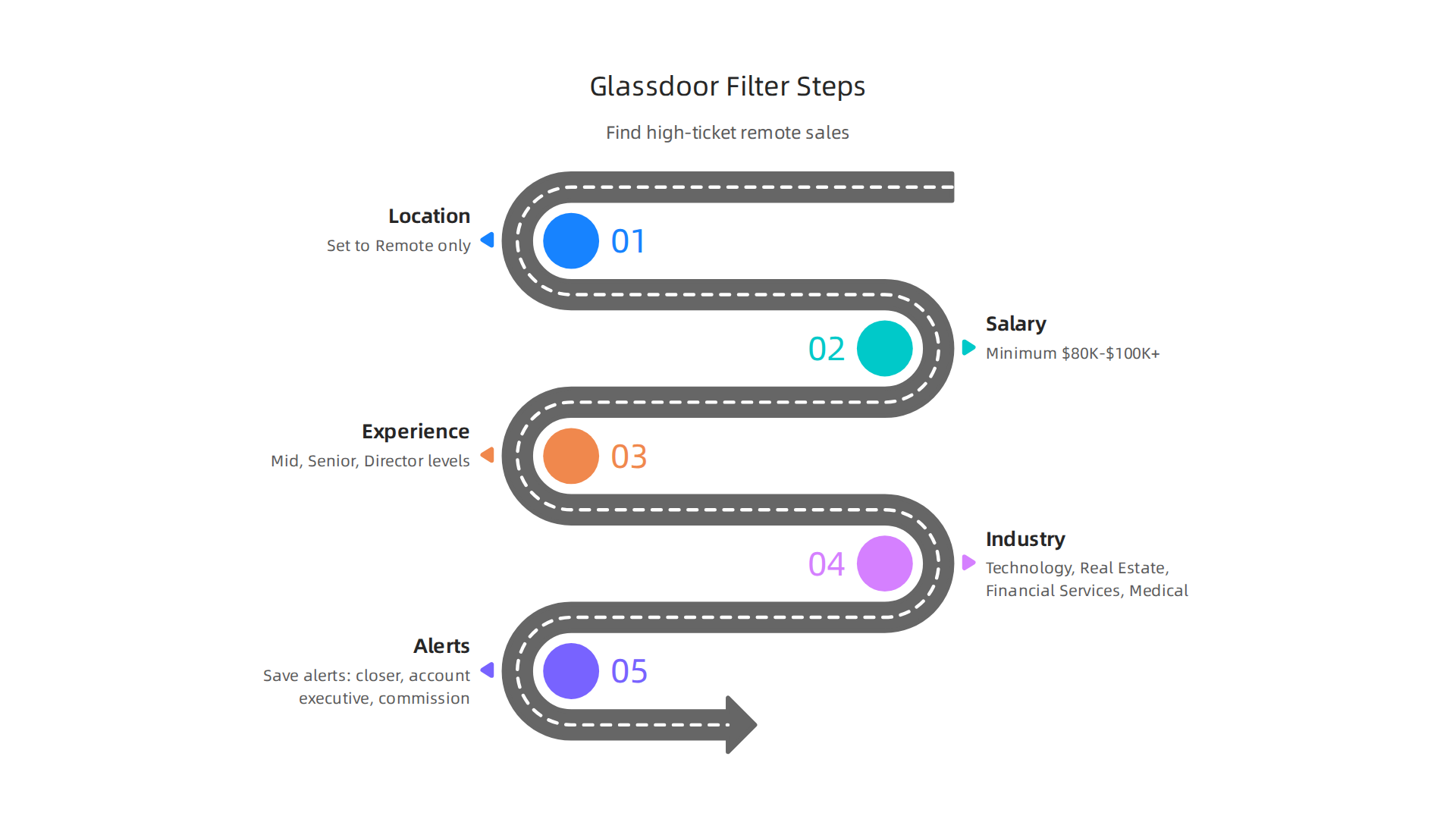
Start with Location and Salary
First, set your location to "Remote." This opens the door to companies everywhere. Do not limit yourself to one city or state. Then set the salary filter. In 2026, high ticket sales roles often start at $80,000 to $100,000 base pay. So set the minimum salary to $100,000 or at least $80,000 depending on your experience. This one filter saves you from scrolling through jobs that do not match your income goals.
You can check out the 2026 sales salary guide from Randstad to see what roles pay in your target range. They break down base pay, commission, and total earnings by role and industry.
Pick the Right Experience Level
Recruiters set experience levels for a reason. If you are a closer with five years of experience, you want "Mid Senior" or "Director" level roles. Do not waste time on "Entry Level" gigs that pay little. If you are newer, start with "Associate" and work up. The filter helps you skip roles that are too junior or too senior for your skills.
Use the Industry Filter to Target High Ticket Sectors
This is where the magic happens. High ticket sales happen in specific industries. Use the "Industry" filter to focus on:
- Technology (SaaS, software)
- Real Estate (commercial, property)
- Financial Services (investments, insurance)
- Medical Devices (equipment sales)
Set it to at least one of these. That narrows your results to companies that sell big deals. A tech sales rep in 2026 earns an average of $112,000 per year according to Built In’s 2026 salary data. That is way above the average remote sales salary of $82,829 reported by Salary.com. The industry filter helps you find those higher paying sectors fast.
Save Job Alerts with Smart Keywords
You do not want to search every day. Save a job alert with keywords like "closer," "account executive," "high ticket," and "commission." Glassdoor will email you when new roles match. Check your settings to get daily or weekly alerts. This way you are first to apply, not chasing old posts.
For a deeper look at where to find these high paying roles, take a look at this guide on how to find high ticket remote sales jobs in 2026. It covers more platforms and tactics beyond Glassdoor.
A few minutes spent setting your filters now can save you hours of wasted scrolling. Let the system do the hard work while you focus on applying to the best fits.
How to Evaluate Company Reviews and Salary Data on Glassdoor
You have your filters dialed in. You see a list of promising glassdoor jobs. Now comes the tricky part. Are these companies actually good to work for? And does the pay match the hype? You need to read the reviews and salary data like a detective.

Let me show you how.
Read Between the Lines in Company Reviews
Do not just look at the star rating. Dig into the actual comments. Look for patterns, not one-off complaints. If you see multiple reviews mentioning management turnover, that is a red flag. High turnover in sales managers often means poor training and shifting quotas.
Also watch for commission disputes. Salespeople live on commission. If a few reviews say "they never paid my commission" or "they changed the commission plan mid quarter," that is a serious warning. According to the Job Scam Red Flags guide, fake positive reviews are a common trick. Look for overly glowing language that sounds scripted. Real reviews have a mix of praise and honest complaints.
Use Salary Estimates to Negotiate Smarter
Glassdoor shows estimated salary ranges from user submissions and employer data. Use this to gauge if a role fits your financial goals. Do not just look at the average. Look at the range. If the range is wide like $60,000 to $150,000, that usually means a heavy commission structure. The company might have low base pay but high upside.
You can use these numbers during negotiation. If the Glassdoor estimate shows $100,000 as typical for a "Senior Account Executive," you can use that as a starting point. Say "I see market data that puts this role around $100,000 total comp. Can we discuss how your package compares?" This works better than guessing.
Be careful though. Salary data can be outdated or skewed. Cross-check with other sources. For extra help landing a high paying role, read this guide on how to find high ticket remote sales jobs in 2026. It covers other platforms beyond Glassdoor.
Spot Red Flags Before You Apply
Fake job postings and scams are growing in 2026. AI makes them harder to catch. Here are specific red flags to watch for:
- Lack of recent reviews. If a company has no reviews from the last six months, that is suspicious. Legitimate companies get fresh feedback.
- Vague job descriptions. If the post uses buzzwords like "rockstar" or "ninja" but does not explain the product or comp plan clearly, skip it. High ticket sales roles should be clear about what you sell and how you get paid.
- Multiple identical positive reviews. Spot a pattern of reviews that say the exact same phrases? That is a sign of fakes.
- Too much salary promise. If the estimated salary is way above industry average for the role and experience level, it could be a lure.
The official Glassdoor Help Center on fraudulent postings warns users to verify the company website and contact them directly if something feels off. Also, the WeWorkRemotely job scam alert lists nine red flags for remote jobs, including vague job details and pressure to pay for training.
Trust Your Gut
If a company’s reviews feel weird or the salary seems too good, trust that feeling. There are plenty of best remote jobs out there. Do not waste time on companies with shady reviews. Use the data to find the ones that treat their salespeople well and pay what they promise.
Spending 15 minutes reading reviews and salary data can save you months of misery at a bad company. Make it part of your routine for every glassdoor jobs posting you consider.
Networking with Employers on Glassdoor
Once you have verified a company is legitimate and pays well, the next step is to get noticed. Glassdoor is not just a research tool. It is also a networking tool. You can actively connect with recruiters and hiring managers directly through the platform. Here is how to use Glassdoor to build real connections and land one of those best remote jobs.
Use Easy Apply the Right Way
The Easy Apply button is tempting because it is fast. But fast applications often get ignored. You need to customize your cover letter for each job. Do not send a generic copy. Mention the specific role and why you fit.
Include something you learned from the company’s Glassdoor reviews. For example, say "I saw your team values work life balance, and that matches how I operate in a remote role." This shows you did your homework. It makes your application stand out among dozens of lazy ones. If you are aiming for a high ticket role, this extra effort pays off.
Direct Message Recruiters and Sales Managers
Glassdoor allows you to message recruiters directly in many cases. Use this feature like a salesperson. You are selling yourself. Keep your message short and clear.
Start with a friendly greeting. State your interest in a specific role. Mention one relevant skill or result. End with a question that invites a reply. For instance: "Hi [Name], I saw the Senior Account Executive role on Glassdoor. I have closed over $500K in SaaS deals remotely this year. Would you be open to a quick chat this week?"
This approach works well because it respects their time. According to a guide on becoming a high ticket closer, connecting directly with decision makers is a key skill for sales success. Practice this on Glassdoor first.
If you want to learn more about landing roles in high paying fields, read this guide on how to find high ticket remote sales jobs in 2026. It covers other platforms and strategies beyond Glassdoor.
Follow Companies and Engage with Their Content
Following a company on Glassdoor signals genuine interest. It also puts their job postings at the top of your feed. Engage with their Glassdoor content when possible. Some companies post updates, photos, or answer questions. Comment thoughtfully or ask a question about company culture.
This builds familiarity. When a recruiter sees your name pop up multiple times, you become a known quantity. That helps when you finally apply. For sales jobs, being proactive is a huge plus. Recruiters love candidates who show initiative.
Building relationships on Glassdoor takes a few minutes per day. But it can lead to faster responses and warmer interviews. Combine this with your research from the previous section, and you have a powerful system for finding great glassdoor jobs.
Common Mistakes to Avoid When Using Glassdoor for Sales Jobs
Using Glassdoor the wrong way can actually hurt your chances. It can also lead you straight into a scam. Many people make simple mistakes that cost them time, money, or a good opportunity. Here are the three biggest ones to watch out for.
Applying Without Reading Reviews
This is the most common mistake. You see a shiny job title for a sales role and hit Apply without checking what employees say. Big mistake. Some companies look great on the surface but have toxic cultures, high turnover, or unrealistic quotas. You might waste weeks interviewing only to realize the job is miserable.
Worse, some postings are scams. AI is making fake job listings harder to spot in 2026. Experts warn that remote job scams are a serious threat, and they can target anyone from beginners to seasoned pros. Always check the company’s Glassdoor reviews first. Look for patterns. If multiple people mention bad management, broken promises, or shady pay, run the other way. If a posting feels too easy or asks for money upfront, that is a major red flag. For more help, check out this complete guide on job scam red flags in 2026 to stay safe.
Ignoring Salary Data and Accepting Lowball Offers
Glassdoor gives you salary estimates for a reason. Use them. Many sales reps skip this step and accept offers that are way below market value. This is a huge mistake.
Check the salary range for the specific role and location. Compare it to what other companies pay for similar sales jobs. If the offer is much lower, negotiate or walk away. Accepting a lowball offer sets you back financially and professionally. It also tells the employer you do not know your worth. Burnett Specialists notes that protecting yourself includes verifying pay is realistic and transparent. Do not be shy about asking for market rate. You deserve it.
Using the Same Generic Resume for All Applications
This is a fast track to the rejection pile. Sales hiring managers see hundreds of generic resumes. They toss them in seconds. You need a customized resume for each glassdoor job you apply to.
Tailor your resume to match the specific job description. Use the same keywords the employer uses. Highlight relevant sales results that match the role. This shows you read the posting and care about the job. It takes a bit longer, but it gets you many more interviews.
Avoid these three mistakes and you will save time, avoid scams, and land better offers. For a more structured approach to finding great roles, check out this guide on how to find high ticket remote sales jobs in 2026. It covers platforms beyond Glassdoor and keeps you ahead of the curve.
Your 7-Day Glassdoor Job Search Sprint for High-Ticket Sales
You do not need to spend months searching for the perfect sales job. A focused one-week sprint using Glassdoor jobs can land you quality leads fast. Here is a simple day-by-day plan.
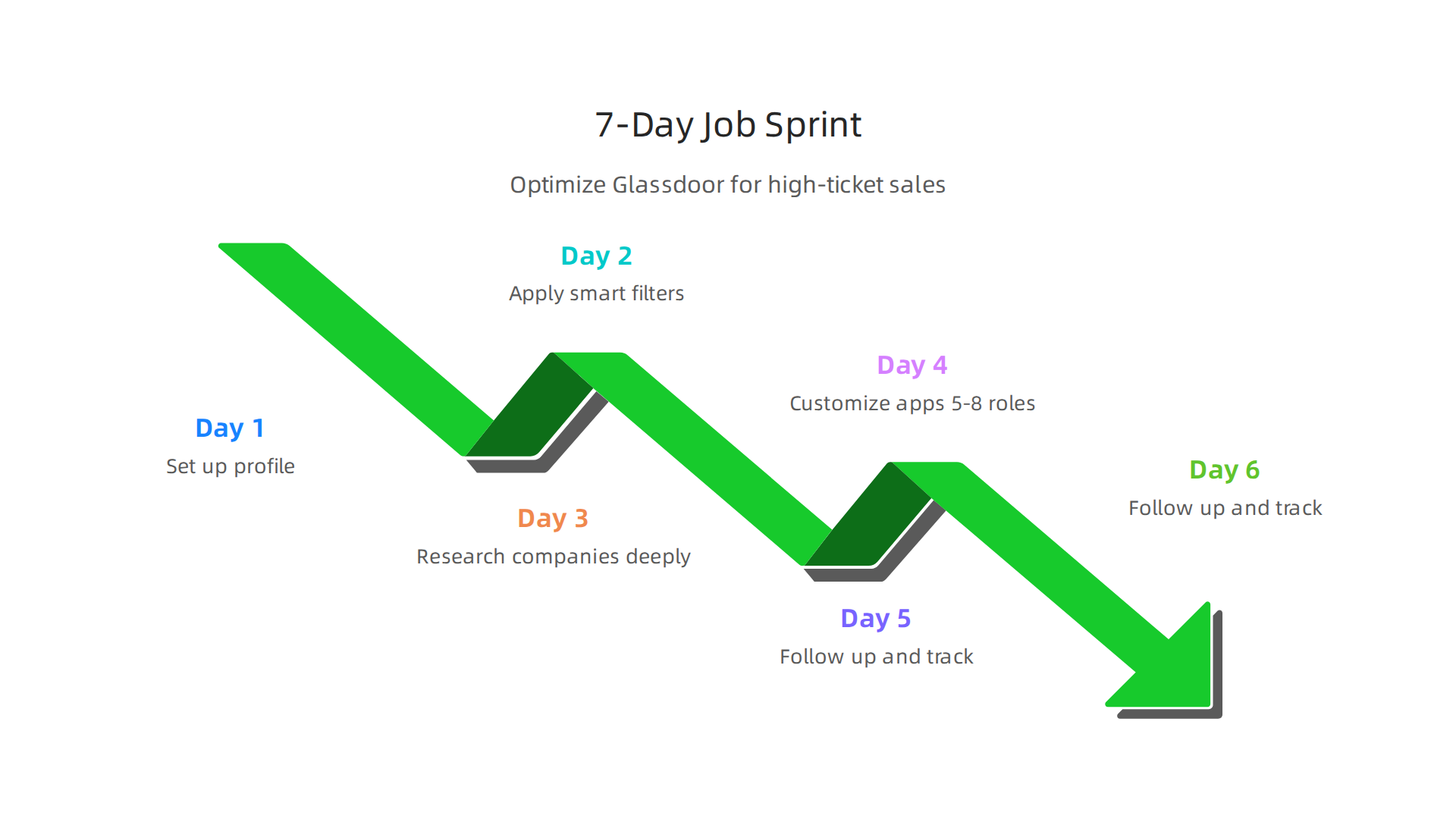
Day 1: Set Up Your Profile
Optimize your Glassdoor profile. Use a professional photo and a headline that matches high-ticket sales roles. Update your summary with keywords from real job postings. One smart tip from the NES Core Source job search guide is to copy important terms directly from job descriptions into your resume and profile. This helps you get past automated filters.
Day 2: Apply Smart Filters
Do not browse everything. Use Glassdoor’s filters to narrow to remote or hybrid sales jobs with a salary range above $80,000. Focus on roles where your impact shows fast, like high-ticket closing or business development. The CBH job search tips recommend targeting positions where you can demonstrate quick wins. That fits perfectly with high-ticket sales.
Day 3: Research Companies Deeply
Read at least 10 reviews for each company you like. Look at industry reports on Glassdoor to spot skill gaps. For example, if many postings ask for CRM expertise or cold calling experience, you know what to learn. A 2026 job market overview from Robert Half shows that companies are hiring for specific, measurable skills. Use this intel to decide if you need a certification or a short course.
Day 4: Apply with Customization
Apply to 5 to 8 roles per day. Tailor each resume using the keywords from the posting. Do not send the same generic file. This step alone triples your interview chances.
Days 5-7: Follow Up and Track
Use a simple spreadsheet to log companies applied, follow-ups, and interview dates. Send a polite follow-up email two days after applying. Track your progress every evening. This keeps you accountable and helps you spot which filters or approaches work best.
For a deeper dive on finding remote high-ticket sales opportunities beyond Glassdoor, check out this guide on how to find high ticket remote sales jobs in 2026. Stick to the sprint, and you will have solid leads by the end of the week.
Summary
This article shows ambitious sales professionals how to use Glassdoor to find genuine, high-paying remote sales roles in 2026. It explains what high-ticket sales are, why they pay significantly more than traditional sales, and why Glassdoor’s combination of company reviews, salary transparency, and interview insights makes it uniquely useful. You’ll learn how to optimize your Glassdoor profile with the right keywords, set filters to target remote high-ticket opportunities, and evaluate reviews and compensation data like a hiring insider. The guide highlights red flags and common mistakes that lead applicants into scams or lowball offers, and offers practical outreach and networking tactics for connecting with recruiters. Finally, it gives a focused 7-day sprint you can run to generate quality leads and start getting interviews quickly.